Our new book on circular cities and regions, edited by yours truly, Karel van den Berge, Joanna Williams, and Ellen van Bueren, is out, for now in an e-book format. The book was prepared as part of our Regional Studies Association’s Policy Expo project and offers a fresh perspective on what circular economy means for cities and regions in compact format and accessible language, supported by infrographics.

Cities and regions globally face significant challenges, including environmental degradation, resource scarcity, economic instability, and social inequality. The circular economy offers a transformative framework to address these issues by rethinking material and energy flows and minimizing resource consumption. However, its success hinges on recognizing the unique spatial dynamics of cities and regions and integrating them into circularstrategies.
Going circular explores the potential of circular economy as a transformative concept for cities and regions. It examines how spatial planning policies can incorporate circular principles to promote sustainability, justice, and resilience. The book emphasizes that place-based approaches are essential for advancing circular economy while avoiding its reduction to apolitical or purely technical frameworks.
The book highlights six key themes:
- The Spatial Dimension: Circular economy strategies must address the spatial specificities of cities and regions, balancing resource flows while mitigating negative externalities.
- Geopolitical Opportunities: Global geopolitcal crises, such as the war in Ukraine, underscore the need for localized resource systems to enhance resilience and self-sufficiency.
- Social Inclusion: Circular economy policies should integrate equity and care, addressing socio-spatial disparities and ensuring socially just transitions.
- Circular Bioeconomies: Metropolitan regions must adopt regenerative practices that link cities with ecosystems to restore urban and regional ecological health.
- Assessment Tools: Robust metrics are needed to evaluate circular economy’s ecological, social, and economic impacts and to inform spatially sensitive policies and strategies.
- Policy Recommendations: Circular economy policies must integrate principles of regeneration, resilience, and justice across governance scales, recommendations on that are formulated for policymakers operating at the international, national, regional and local levels.
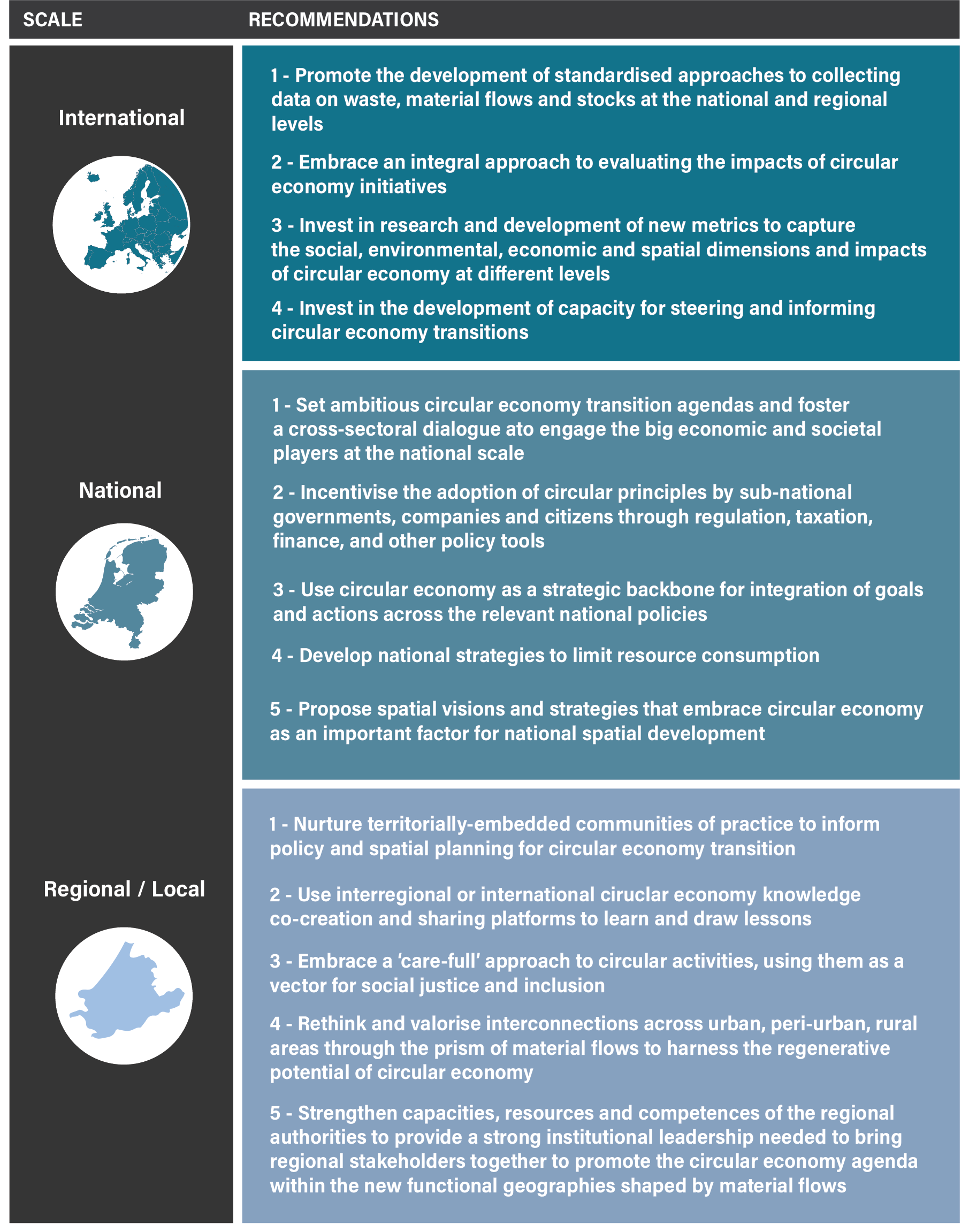
`In the book, we argue that a shift toward spatially aware circular economy policies is vital for addressing place-based challenges and fostering systemic change. Current policies often overlook the social, political, and ecological dimensions necessary for holistic transitions. Arriving at a critical juncture in the climate and resource crisis, Going Circular book urges integrating circularity principles into spatial planning and territorial strategies to drive a sustainable and just future. The book’s case studies and practical insights offer actionable guidance for policymakers, planners, and researchers, but we also think they would be of interest to scholars and students interested in (urban) sustianability tranisitions more broadly and ways in which we could reduce our excessive resource consumption.
You can read the first and the last chapters here for free or purchase the book in digital form. A print paper-back version will be available very soon.
Reference:
Dąbrowski, M., van den Berghe, K., Williams, J., van Bueren, E., Eds. (2024). Going Circular: Unlocking the Potential of Regions and Cities to Drive the Circular Economy Transition. London: Routledge (Regional Studies Policy Impact Books).Link

 Marcin Dąbrowski