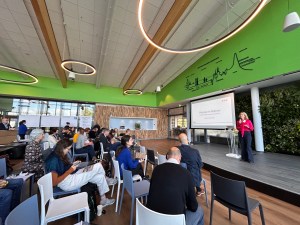
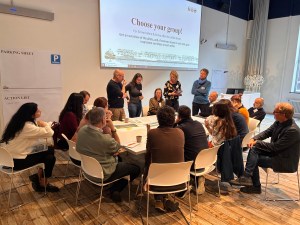
Our new Horizon Europe research project called SPADES (Spatial Planning and Design with Soil) was kicked off this week in Delft. The project, funded by Horizon Europe programme and led by Deltares, will seek to promote the integration of a soil-health perspective in spatial planning to develop, test and implement soil-inclusive spatial strategies across a range of pilot locations in Europe. The project is part of the EU Soils Mission effort. My role in the project is mainly in WP1 which does an inventory of approaches to soil health in spatial planning, overview of the concepts used therein and strategies for spanning boundaries between the soil and planning worlds. Our TU Delft team further will explore soil-inclusive planning and design practices and work on the Dutch pilot studies. I look very much forward to contributing to this exciting research.

Here is the synopsis of the project:
SPADES’ mission is to develop, test and implement soil-inclusive spatial planning strategies to support the transition towards soil health in Europe. Soil health is highly under pressure and the soil’s ability to perform essential ecosystem services should be improved to cope with pressures such as climate change and need such as a healthy living environment. Spatial planning and design are practices that, when enriched by soil care, can enhance the current status of soils and support societal challenges and needs, while avoiding unwanted trade-offs towards other areas, generations or functions. SPADES will therefor provide a comprehensive state of the art on both planning and design practices, as on soil instruments. To be able to make a transition in spatial planning and design towards healthy soils a fundamental understanding of the current mechanisms is key. SPADES will develop integrative instruments and improve the information basis and brokerage to bring the spatial planning and design field and soil sector together. This will contribute to the methodological basis. SPADES will work in 17 pilots in 10 member states, covering a broad range of land uses (urban, peri-urban and rural areas), time and spatial scales, and soil and planning challenges. This is done together with local practitioners and policy makers to develop fit-for-purpose soil-inclusive spatial strategies to support different goals such as land degradation neutrality and no net land take. The SPADES instruments will be presented in such a way (manual and navigator) so that they can be found by the right user, at the right phase of the planning and design process, and for the right purpose. SPADES supports soil literacy (by capacity building and communication, dissemination and exploitation activities) to a broad range of target groups to enable current practice to improve. To make this most effective, SPADES case partners are involved in these CDE and training activities.
More info: https://spades4soils.eu/
Partners:

 Marcin Dąbrowski