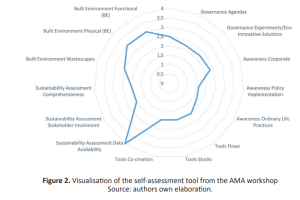
Building on the research conducted as part of the H2020 REPAiR project, which was quite pioneering in exploring the spatial dimension of circular economy, we produced an evaluation framework for gauging the state of progress towards circular economy. The tool was designed for regional and urban policy-makers, planners and stakeholders engaged in development of CE strategies and policies to take stock of how far their city or region is on that path. The tool is holistic insofar as it looks into five dimensions of the transitions towards circular cities and regions: (1) governance structures, (2) awareness, comprehensiveness of the sustainability assessment, (3) tools for measuring material stocks and flows as well as (4) for co-creation of solutions and strategies with stakeholders, and (5) circular built environment. The framework allows for identifying the bottlenecks for transition and set out the agenda for overcoming them. What is more, when applied in several locations, the framework is useful for producing comparative insights into the state of transition towards circular economy and for drawing lessons on what it takes to nudge the development of regions and cities towards circularity. Our just published paper in Europea XXI presents the framework and applies it to two very different cases (Amsterdam and Tomaszów Mazowiecki-Opoczno, Poland).

You can read it here.
Reference:
Wandl, A., Dąbrowski, M., Berruti, G., Acke, A., Obersteg, A., Varjú, V., Taelman, S. E., Arlati, A., Grodzicka-Kowalczyk, M., Kowalczyk, M. (2023) A Holistic Self-Assessment Tool for Circular Economy Transitions in Cities and Regions, Europa XXI, 44, 15-35. https://rcin.org.pl/Content/242277/WA51_279067_r2023-t44_EuropaXXI-Wandl.pdf

 Marcin Dąbrowski