A special issue of Planning Practice & Research co-edited by Francesca Blanc, Giancarlo Cotella and myself is just out. We curated a collection of papers dealing with the under-researched topic of policy transfer in spatial planning from and between the countries of the Global South. The special issue presents insights on how the policy transfer processes work and what makes them succeed and fail building on a number of empirical case studies. Our goal was to shed light on the role of philantropic organisations in policy transfer and the processes of recirculation and adaptation of planning policies to the local contexts. At the same time, the research presented in the special issue provides some cautionary tales to policymakers about the risks that uncritical transfer of spatial planning practices as ‘quick-fix’ solutions may bring (see Sergio Montero’s ‘urban solutionism’ critique).
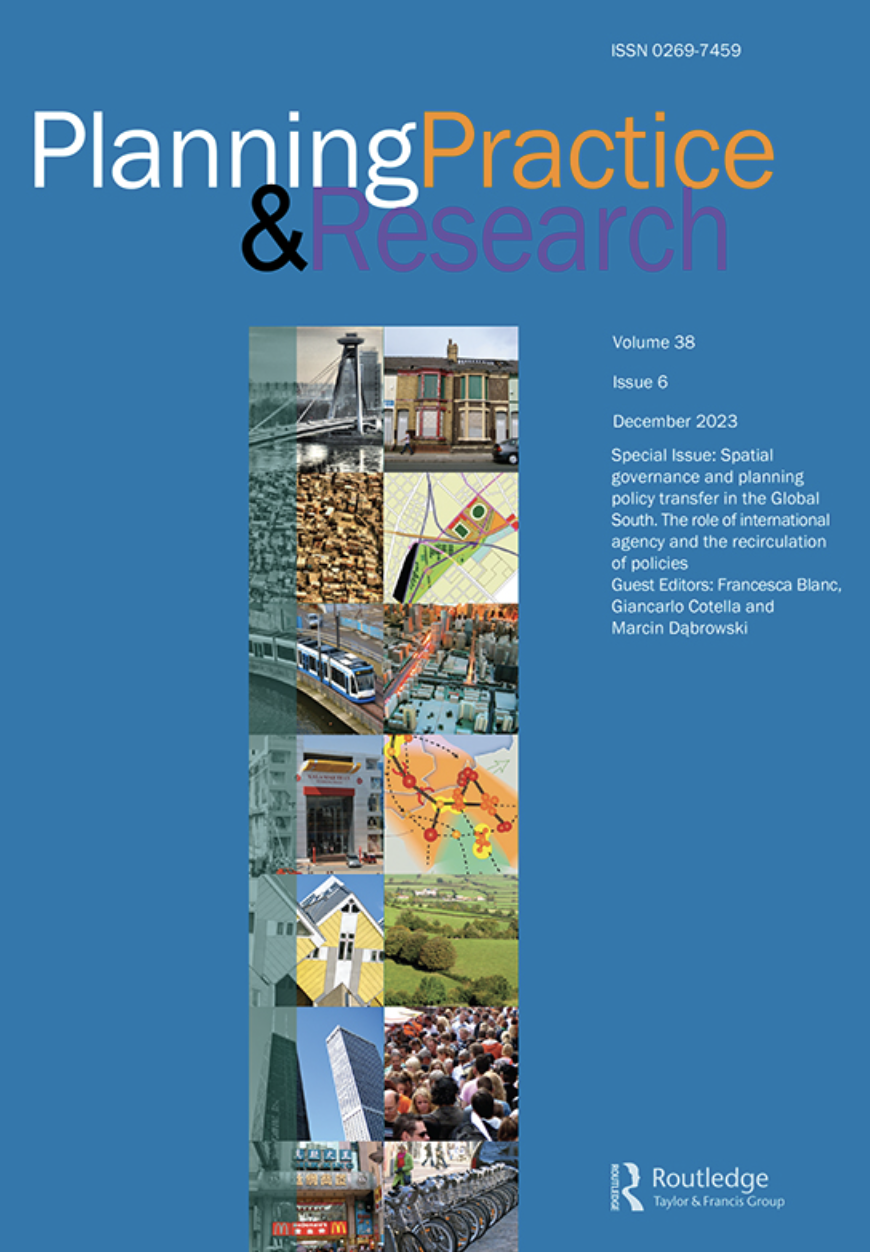
In the editorial to the special issue we sketch out a few agenda points for further research on policy transfer within and from the Global South:
- “We are aware that the Global South is by no means a homogenous environment when it comes to the institutions and processes contributing to policy transfer and mobilities. Further research is certainly needed to broaden the coverage of spatial governance and planning policy transfer in the Global South, by also engaging with other countries from Africa and Asia.”
- “Alongside agents and spaces of transfer, closer attention to the timing of policy transfer is certainly an interesting avenue for future research, which entails consideration of the combination of exogenous inputs with path-dependent logics, and of how the resulting dynamics end up influencing spatial governance configurations and planning practices.”
- “In the light of these multiple, differential aspects of policy transfer failure, we argue that it may be worthwhile to reflect in a more structured manner on their nature and causes. This in turn, could entail building on the many empirical cases that are already covered in the literature to develop a ‘typology of policy transfer failure.’”
- “Another potential exciting research avenue concerns the fact that transfer processes do not limit their impact to the targeted policy area. In most cases, the adoption of an ‘alien’ policy element contributes to trigger a number of spillover effects in the receiving context, for instance, highlighting specific weaknesses of the local institutional environment, or stimulating the correction of mistaken practices in fields that are not necessarily directly linked to the one explicitly touched upon by the policy borrowed from abroad. Moreover, and perhaps more interestingly, in selected cases policy transfer can generate an impact on the institutional environment that has originally generated the policy, as a consequence of reflexive feedback on the functioning of the transferred policy or practice towards its place of origin. As a matter of fact, one could argue that the diffusion of a policy or instrument in multiple contexts may contribute to its incremental fine-tuning and improvement.”
- “Finally, the confluence between local territorial governance and the changing global policy agendas – for instance concerning climate change mitigation and adaptation, public health, or sustainable urban development – should be further analysed by looking at their mutual interactions and at the drivers and agents of policy knowledge transfer, as well as by going beyond a preconceived conceptualisation of a unidirectional transfer from global to local. This research agenda becomes even more pressing when one considers the currently destabilising and shifting geopolitical situation.”
The special issue includes the following contributions:
Spatial governance and planning policy transfer in the Global South. The role of international agency and the recirculation of policies by Francesca Blanc, Giancarlo Cotella & Marcin Dąbrowski (editorial);
Unpacking the Ecuadorian spatial planning law: policy mobilities in Latin America between transnational agency and path-dependent logics by Francesca Blanc;
Multilevel urban policy mobilities through the City Statute: the spreading of Brazilian urban federal law by Rérisson Máximo & Luciana Royer;
Territorializing the climate policy agenda in intermediate cities of the Andean Region by Andrea Carrión, Pere Ariza-Montobbio & Diana Calero;
Transferring transport policy problems: the instrumental role of social concerns in policy transfer by Giovanni Vecchio;
The role of municipal knowledge management vehicles in facilitating international knowledge sharing and policy mobility: the Durban story by Sogen Moodley.
In addition, this paper on social housing in Taiwan was originally also meant to be included as part of this collection:
Beyond Conditionality: Community Placemaking in Taiwanese Social Housing Management by Hsinko Cinco Yu, Tsai-Hung Lin & Marcin Dąbrowski.

 Marcin Dąbrowski